
Wireless for home and office
Requirements differ greatly between environments, so a clear understanding of the network's purpose is the first condition for a good design. Using industry-standard tools, we design and predict the behaviour of the future network and plan ahead for:
- The desired throughput
- Capacity — the expected number and type of client devices
- Radio frequencies — optimal channel distribution and transmit power
- Redundancy
Together with thorough preliminary measurements, this lets us deliver the best possible wireless infrastructure — with the right hardware for the job.
Wireless site surveys
As well as part of a design, we offer surveys as a service on their own. A detailed survey helps with:
- Designing and planning a new network
- Optimising an existing network
- Finding and resolving problems
- Interference — poor performance, intermittent connectivity
We work with Ekahau tools — one of the leading vendors in the field — for multi-floor design, surveys and spectrum analysis.
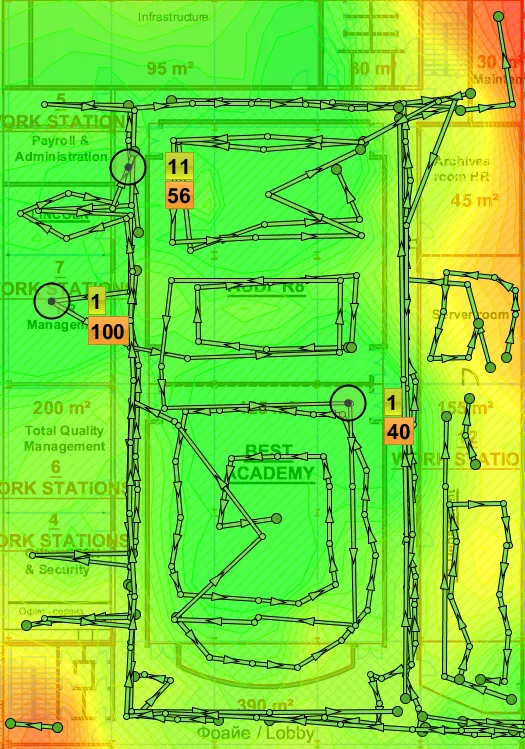
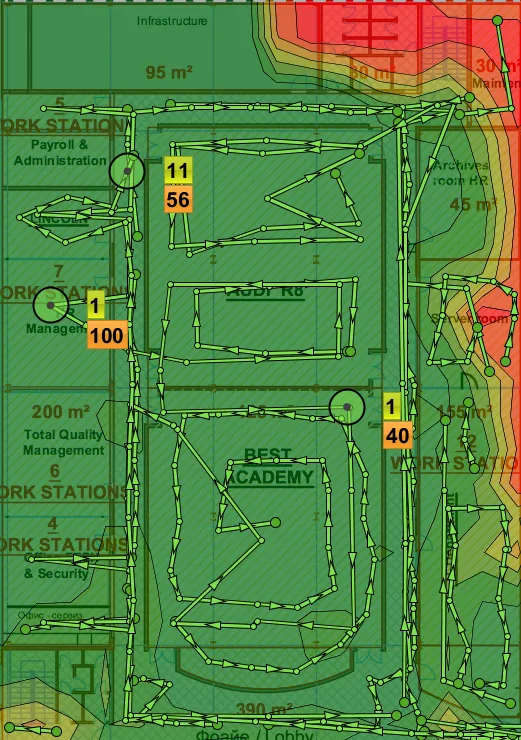
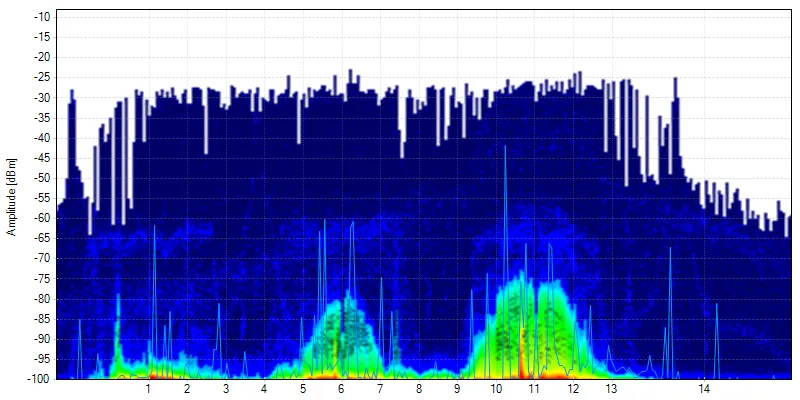
Our survey reports include:
- Compliance with the agreed requirements, and any deviations
- Signal strength map (RSSI)
- Channel distribution and overlap
- Access point locations
- Rogue access point locations
- Signal-to-noise ratio map (SNR)
- Throughput — simulated and measured
- Associated access point map and roaming behaviour
- Maximum data rate at every point
- Spectrum channel power and spectrum utilisation
- Identified interference and optimisation recommendations
Spectrum analysis
We measure the 2.4 GHz and 5 GHz bands for external, non-802.11 sources of interference. The reports include:
- Density views — signal levels and utilisation across the spectrum; most modulations are easy to recognise
- Waterfall graphs — duty cycle and airtime used by each source
- Spectrum utilisation — per channel and frequency
- Networks, channels and devices — every 802.11 network and device heard during the recording
Infrastructure wireless
The line between a simple wireless network and infrastructure wireless isn't always obvious, but when you move from the office to an industrial environment all the requirements change. We have extensive experience with industrial-grade wireless — from point-to-point and point-to-multipoint links to large, redundant mesh networks for some of the biggest industrial customers in Bulgaria.
- Centralised management with redundant controllers
- Automatic radio resource management (RRM) adapting to the environment
- Load balancing of clients between access points
- A high level of security using proven standards
- Interference and rogue device detection
- Monitoring and reporting that cut operating costs